
Supply Chain Resilience Strategies: The Line Between Your Extinction and Your Survival.
Diversifying production is no longer a refined option. It is survival. It is evolution. Today, supply chain resilience strategies are no longer theoretical frameworks — they are a matter of survival, because for the past 30 years we optimized the world for a single objective: extreme efficiency — and by doing so, we removed resilience from the equation.
The era of hyper-globalization turned the planet into a factory without walls. Energy, capital, and data flowing frictionlessly — in theory. We assumed it would never stop. But the first decades of the 21st century made one thing clear: that system is no longer viable.
Evolution does not reward the most efficient. It rewards the most adaptable.
And today, the scarcest asset is not resources. It is the ability to withstand, reconfigure, and keep operating when everything breaks. This is where effective supply chain resilience strategies move from theory to necessity.
Now, consider this for a moment: Imagine your business operating outside of conflict. Not reacting to disruption, but structurally removed from it. Positioned in a region with access to resources, energy, and talent — while others are still trying to stabilize.
This is not a theoretical advantage. It is a strategic positioning most companies have not yet understood.
How Did We Get Here And Why The System Is Broken
The global production system did not fail by accident. It was designed this way. Each industrial revolution pushed for more efficiency — and more fragility:
- Industry 2.0 (electricity and oil): mass production, resource wars, the birth of structured global trade
- Industry 3.0 (computing and globalization): fragmented production, offshoring, dependency on Asia, fiat money, and extreme financialization
- Industry 4.0 (AI, data, automation): total hyperconnectivity, built on a physical foundation that was never designed to withstand shocks
The result: a system that performs brilliantly under ideal conditions — and becomes very expensive under pressure.
The Critical Mistake: We Optimized For Efficiency, Not Survival
Modern supply chains are the nervous system of the world. And they are built on a dangerous logic:
- Globally fragmented production
- Dependence on comparative advantages (talent vs cheap labor)
- Elimination of inventory (Just-in-Time model)
Just-in-Time is not innovation. It is a bet. It removes buffers, removes redundancy, removes margin for error. It works — until it doesn’t.
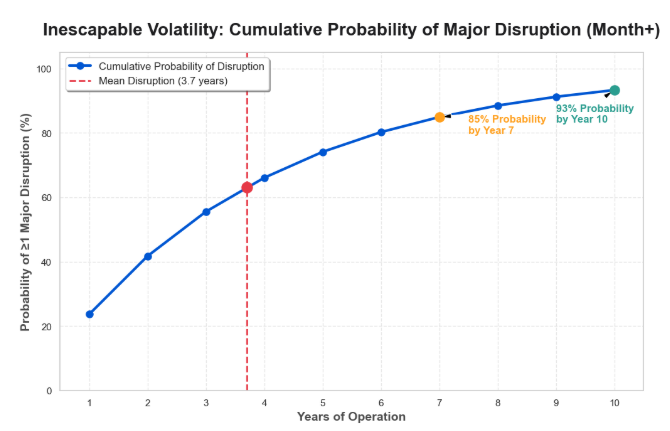
Key data point: According to a McKinsey report, companies face disruptions of one month or more every 3.7 years. Yet our system rewards those who operate “at the edge,” with margins measured in hours.

Translation: we are running a critical global system with no safety net.
This is exactly why modern supply chain resilience strategies are no longer optional — they are the foundation of survival.
Breaking Points: The Real Pain Points
This is the problem no one wants to say out loud:
Extreme Geographic Dependency
The world depends on a handful of critical nodes. Despite the digital era, 90% of global trade still moves by sea. Supply chains depend on geographic chokepoints located in high-tension regions:
- Strait of Malacca
- Suez Canal
- Panama Canal
- Pacific Corridors
If one fails, everything fails.
Zero Redundancy
Efficiency turned into rigidity. When the Suez Canal was blocked or ports shut down during the pandemic, there was no “Plan B” because Plan B costs money and reduces quarterly dividends.
We have concentrated fuels, strategic components, and critical infrastructure for global production into a few geographies.
- No fallback suppliers
- No regional buffers
- No operational redundancy
When supply is disrupted in Asia, the United States, Europe, and Latin America are all affected simultaneously.
And at that point, efficiency becomes far more expensive than redundancy.
Proven Fragility (Not Theoretical)
The Ever Given incident in 2021 was a warning that exposed global fragility:
- $9.6B daily trade halted
- $79.6B global impact
- One ship, one point, system collapse
Energy As The Weakest Link Of The Supply Chain
The closure of the Strait of Hormuz in 2026 escalated this vulnerability to an existential level:
- 20% of global oil compromised
- 25% of LNG at risk
- Direct impact on fertilizers, food, and production
When energy fails, everything fails.
The Invisible Factor: Culture And Execution
Not all regions operate the same way:
- Asia optimized precision and scale
- The U.S. dominates software, brand, and capital
- Europe leads in high-value engineering and design
- China dominates industrial clusters and speed
But there is an underestimated player: Latin America is the resilient operator.
While the world operated in controlled environments, LATAM operated in constant crisis. This creates capabilities that cannot be simulated:
- Real adaptability
- Efficiency under pressure
- Ability to operate without ideal conditions
From Latin America, we have proven that resilience can be trained.
The Great Break: The Collapse Of Certainty
The 21st century has been a controlled demolition of the pillars of stability.
From 2008 to today, the system has not stopped breaking:
- Global financial crisis
- Pandemic
- Russia–Ukraine war
- U.S.–China tech war
- Global energy crisis
These are not isolated events — this is the system evolving. And adaptability is the most valuable resource in times of change.
The New Paradigm: Market 4.0 — Resilience As The New Productivity
We are entering the end of the “growth at all costs” era and the beginning of strategic redundancy.
To compete today, companies must adopt supply chain resilience strategies that prioritize:
- Regional supply chains, not global
- Distributed production, not centralized
- Traceability, sustainability, and security as requirements
We are entering a new era:
- End of “growth at all costs”
- Beginning of strategic redundancy
- Regional supply chains, not global
- Distributed production, not centralized
- Traceability, sustainability, and security as requirements, not extras
Closing data point: In 2026, nearshoring to Latin America has grown at 15% annually, driven by companies that prefer the region’s geographic stability over geopolitical risks.
The market has changed. The customer no longer buys price — they buy certainty. If you want to understand how this transformation is already happening globally, read:
So, What Is The Problem We Solve?
The world needs to rebuild its ability to produce — without collapsing. Today, global companies face a critical gap:
- They cannot trust their current supply chains
- They do not have alternative infrastructure ready
- They do not know how to operate in unstable environments
- They lack the speed to reconfigure
The Operating Layer: From Strategy To Execution
This is where Better Technologies comes in. We don’t sell outsourcing. We don’t sell traditional consulting.
We build:
- Resilient regional ecosystems
- Functional nearshore operations
- Digitalization, localization, and automation of operations
- Strategic redundancy without destroying cost structures
- Production infrastructure aligned with the new geopolitical landscape
We don’t theorize about supply chain resilience strategies. We implement them.
The Opportunity For Those Who Understand The Game
As the global system fractures, LATAM becomes relevant again. There is a window opening — one that does not appear often. The first companies to reposition their operations will not just adapt. They will define their industries.
Imagine being part of that first wave:
- Operating from a region structurally removed from conflict
- With access to energy, resources, and talent
- While others are still reacting to disruption
While others are constrained by instability, you operate from a system designed for what comes next.
The world is not looking for efficiency. It is looking to adapt and evolve. And that — is exactly what we know how to do. Evolution comes from finding a way to do Better.
FAQ
What are supply chain resilience strategies?
Supply chain resilience strategies are approaches that help companies anticipate, withstand, and recover from disruptions by diversifying production, regionalizing operations, and building redundancy into their systems.
Why are traditional supply chains failing?
Traditional supply chains were optimized for cost and efficiency, not disruption. Global shocks exposed their lack of flexibility and redundancy.
How can companies improve supply chain resilience?
By nearshoring, diversifying suppliers, investing in digital infrastructure, and reducing geographic dependency.
Why is Latin America relevant for supply chain resilience?
Because it combines resources, energy, geographic positioning, and operational adaptability — making it ideal for resilient regional supply chains.