
Latin America Supply Chain Solutions: The Operating System for the 21st Century And the Solution Layer Behind It
Global supply chains are no longer being optimized. They are being rebuilt. What was once a decades-long pursuit of cost efficiency has turned into a structural redesign driven by geopolitical fragmentation, energy constraints, AI-driven logistics systems, and the fragility of long-distance production networks.
As explored in nearshoring supply chains, global production is shifting toward regional operating systems instead of global efficiency chains. In this new system, companies are no longer searching for suppliers. They are searching for Latin America supply chain solutions that can operate entire production ecosystems with resilience, speed, and scalability.
Because the third global industrial shift is already underway: Asia was the factory of the 20th century. The United States was the innovation engine.
Latin America is becoming the operational backbone of the 21st century.
This article does not only describe a structural shift in global production. It also shows the emerging solution to it. Because while supply chains are fragmenting, energy systems are decentralizing, and geopolitics is reshaping trade routes — a new operational model is forming in Latin America.
And within that model, Better Technologies emerges as the coordination and execution layer that turns structural potential into scalable reality.
Why Latin America Supply Chain Solutions Are Emerging Now
The global system is converging under pressure. Five structural forces are reshaping production:
- Energy volatility and rising AI-driven demand
- Geopolitical fragmentation
- Regulatory pressure around carbon and traceability
- Breakdown of long-haul logistics efficiency
- Regionalization of production networks
These pressures are not temporary disruptions — they are structural. But while many regions are affected, only a few can absorb this shift. Latin America is one of them.
From Globalization to Regional Supply Chain Systems
For decades, global supply chains were designed for optimization. Today, they are being redesigned for survival. This is the rise of nearshoring supply chains, where production is relocated closer to consumption markets to reduce risk and increase control. This shift represents a structural break in how global production networks are organized.
Latin America is not an alternative in this model. It is a structural node within it.
The Structural Drivers Behind Nearshoring Supply Chains
The shift toward regional production is not driven by a single factor. It is the convergence of multiple system shocks. As outlined in supply chain resilience strategies, these pressures are not temporary disruptions — they are structural.
Energy as a structural constraint
AI-driven logistics, data centers, and electrified production systems are dramatically increasing global energy demand. Production location is now constrained by energy availability, not just labor cost.
Critical minerals and industrial relocation
Global supply chains are moving from oil-based logistics to mineral-based systems. Lithium, cobalt, and rare earths define where manufacturing clusters emerge.
Regulatory enforcement through traceability
Markets, especially in Europe, increasingly require full carbon and supply chain transparency. Without digital traceability systems, market access is restricted.
Geopolitical fragmentation
Long-haul maritime dependency is becoming a structural risk, especially on routes like Suez and Malacca.
Regionalization of production
Global networks are fragmenting into regional clusters to reduce systemic exposure.
Paraguay and the Energy Foundation of Latin America
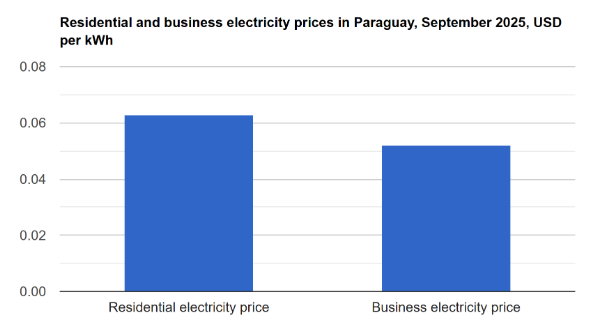
Energy is no longer an input variable. It is a location filter. Paraguay illustrates this shift more clearly than almost any other country. It offers a rare “triple advantage” in energy: ultra-low electricity costs, near-100% clean generation, and a large exportable surplus.
Industrial electricity prices are around $0.04–$0.05 per kWh, among the lowest in Latin America, driven almost entirely by hydroelectric generation. More than 99% of electricity comes from renewable sources, primarily through large-scale hydro infrastructure such as the Itaipú and Yacyretá dams.

At the same time, Paraguay produces significantly more electricity than it consumes domestically, exporting surplus energy to neighboring countries — a structural advantage confirmed by international energy data sources and World Bank energy indicators.
In a system where AI, automation, and electrified industry are scaling rapidly, this type of energy profile becomes a strategic advantage — not just a cost benefit.
THE EUREKA MOMENT: The System Is Already Changing
All of these forces are not separate trends. They are converging into a single structural transformation.
Nearshoring is not logistics. Energy is not infrastructure. AI is not software. Latin America is not a region.They are all expressions of the same shift: The reorganization of global production into regional operating systems.
The pressure described in supply chain resilience strategies is what makes this transition inevitable. And this is the point the market still misses. Latin America is not participating in this transition. It is becoming one of its core operating environments.
The LATAM 4.0 Operating System Powered by Better Technologies
Latin America is not being integrated into the global system. It is forming its own operating layer inside it. This layer is defined by five structural capabilities:
- Critical mineral supply chains (lithium triangle: Argentina, Bolivia, Chile)
- Renewable energy abundance (hydro, solar, wind)
- Agricultural production capacity for global food systems
- Strategic proximity to North American consumption markets
- Dual-ocean logistics access enabling global trade flexibility
But structural capability alone is not enough.Because infrastructure without coordination does not scale. And this is where Better Technologies becomes decisive.
Better Technologies acts as the execution and coordination layer of LATAM 4.0 — transforming fragmented regional strengths into integrated, scalable supply chain systems.
Built on principles developed through the Better Technologies Public Venture Lab, it operates at the intersection of:
- supply chain intelligence systems
- energy-aware industrial planning
- digital traceability architecture
- and regional production orchestration
In other words: Latin America provides the raw system potential. Better Technologies enables system activation. This is the missing layer that turns structural advantage into operational reality.
Because in the new global system, the real constraint is no longer resources. It is coordination at scale.
From Efficiency to Viability
The global system is undergoing a fundamental inversion. Old logic: maximize efficiency. New logic: ensure viability. This shift is visible across industries:
- Cheap labor → Talent + automation
- Oil logistics → critical mineral logistics
- Global shipping routes → regional supply chains
- Opacity → full traceability systems
In this system, the winner is no longer the cheapest producer. The winner is the one that does not break under stress. And Latin America is structurally aligned with that requirement.
Conclusion
Latin America is no longer a passive participant in global trade. It is becoming an operational layer of the global economy. And companies that understand this shift early are not just adapting. They are repositioning themselves inside the next industrial system.
But the real differentiator is not geography. It is execution.
And solutions for supply chains only become scalable when they are enabled by coordination systems like Better Technologies — the execution layer of the new industrial order. Latin America supply chain solutions are not a strategy. They are infrastructure for the 21st century.
FAQ
What are Latin America supply chain solutions?
Latin America supply chain solutions refer to emerging regional industrial systems that combine nearshoring, renewable energy capacity, critical mineral access, and logistics proximity to support global production networks.
Why is Latin America important for global supply chains?
Latin America is strategically important because it combines resource abundance, renewable energy potential, proximity to major consumption markets, and growing industrial capacity, making it a key region in nearshoring supply chains.
What makes Latin America different from other nearshoring regions?
Unlike low-cost manufacturing regions, Latin America offers a structural combination of energy stability, resource access, and operational experience in volatile environments, making it more resilient under global uncertainty.
What is the EUREKA moment in Latin America supply chain solutions?
The EUREKA moment is the realization that Latin America is not just responding to global supply chain shifts — it is becoming one of the central operating systems of the new regionalized industrial economy.